How to Get Smoke Smell Out of Clothes
Plan care for ordinary smoke odor using the garment label, separate storage and a suitable wash; recognize soot, fire and unknown-fume limits first.
Resolve the exposure before treating the garment. Ordinary lingering smoke odor and fire-damaged clothing are different tasks. A household wash cannot certify that unknown contamination is safely removed.
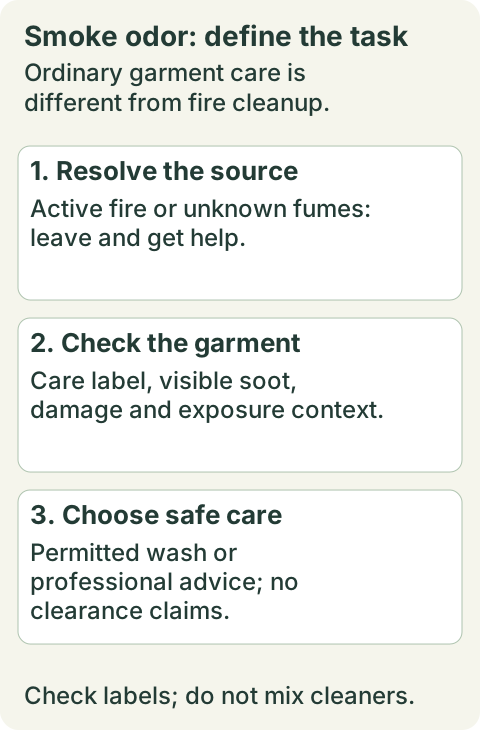
Separate ordinary smoke odor from an active hazard
This guide helps with a garment that has a lingering smoke smell after an exposure has ended and ordinary care is appropriate. Examples might include otherwise washable clothing worn near a campfire or kept in a smoky setting. It does not certify that clothing affected by a building fire, unknown chemicals or heavy soot is safe to wear after a household wash.
If a fire is active, get out and call for help. After a home fire, the American Red Cross says to stay out of the damaged home until local fire authorities say it is safe to re-enter. Do not retrieve laundry while a building is unsafe. Burning, unknown fumes or symptoms during exposure take priority over cleaning an item.
Poison Control explains why smell cannot serve as a safety test: some gases have little or no detectable odor, and unknown fumes can irritate or harm people. A garment smelling less smoky does not prove decontamination. The first decision is whether you have an ordinary clothing-care task or need safety and cleanup advice for the exposure.
Check the label, visible condition and exposure context
| Situation | Useful next step | What this does not prove |
|---|---|---|
| Ordinary lingering odor on a washable item | Follow the finished garment’s permitted wash and dry | That all possible contamination is removed. |
| Dry-clean-only or valuable construction | Ask the maker or cleaner about the exposure | That a household soak is safe. |
| Heavy soot, scorch or unknown chemicals | Seek item-specific cleanup advice before treatment | That less odor means safe to wear. |
| Ongoing smoky storage environment | Resolve the source and protect cleaned garments | That another detergent dose fixes the room. |
| Active fire or unsafe damaged building | Leave and follow emergency/re-entry guidance | That laundry should be retrieved now. |
Read the actual label, including drying and trim restrictions. Look for visible deposits, scorch, damaged fastenings or lining problems without spreading debris around the home. Keep affected items separate from clean laundry while deciding what care is appropriate. Explain the exposure honestly if you contact a cleaner; “smells odd” gives less useful information than a known fire or soot history.
A visible mark and a lingering smell are different observations. Do not automatically scrape, brush, blot or treat the whole garment with dish soap because a generic stain guide says those actions work for another substance. Some soot- or fire-affected items need professional handling rather than ordinary stain removal.
End the exposure and choose a safe place for the item
Before washing, consider whether the item will return to the same smoke source. Keep cleaned clothing away from the smoky room, bag or storage area while the source is being addressed. If the odor returns only after storage, record that pattern rather than repeatedly changing detergents. A garment-care process cannot resolve an active environmental exposure.
Safe airing in clean air may be a preliminary option when the item’s care and the setting allow it. Use a suitable support and respect limits on sunlight, heat and hanging. Do not place a wet or heavy knit on a hanger just because airing is suggested for a different garment. There is no universal number of hours after which smoke odor or contamination is guaranteed to disappear.
Do not add perfume as evidence of successful cleaning. Fragrance changes the perceived smell but does not establish what remains. Keep the task simple: end the exposure, check care permission, then use the permitted cleaning method. If the exposure is unknown or substantial, seek advice before bringing it into an ordinary household wash.
Use a garment-appropriate wash instead of a cleanup mixture
For an otherwise suitable washable garment, sort by care needs and color, choose a washer-compatible detergent, and measure its labeled dose for the load and conditions. Allow room for movement and rinsing. Use the garment’s permitted method and temperature; neither a hot wash nor a cold wash is a universal smoke-removal guarantee.
Do not pour a caustic fire-cleanup product, chlorine mixture or deodorizing home recipe into the machine without specific garment, product and appliance permission. The Red Cross cleanup page itself warns that trisodium phosphate is caustic and calls for testing and manufacturer instructions. Its fire-cleanup recipes are not reproduced here as ordinary clothing-care instructions.
Bleach permission is a separate decision. The ACI bleach guide distinguishes product types and warns about dangerous mixtures. Never mix bleach with acids, ammonia or another cleaner. A successful smell change is not proof of disinfection. If your item is dry-clean-only or the exposure is uncertain, obtain appropriate advice rather than turning one wash into a series of uncontrolled treatments.
Rinse and dry as the item permits, then reassess
Complete the chosen wash and rinse according to the product and machine instructions. Follow the garment’s permitted drying method and support. ACI advises putting away clothing only when fully dry. Check thick seams, lining and folds before closed storage; a warm garment is not necessarily dry throughout.
After a permitted clean and dry, note the result without intentionally exposing yourself to unknown vapors. If ordinary lingering odor remains, review the care process and ask for item-specific advice before another treatment. This guide does not claim that dryer heat permanently fixes every smoke odor into fabric or that air drying alone removes contamination.
If there are visible stains, assess those separately using advice for the actual substance and garment. A stain warning to check a mark before drying is not a universal rule about all odor. Avoid increasing heat, adding bleach or scrubbing delicate areas just because the first wash did not deliver a promised overnight result. No such result is guaranteed here.
Know when to stop and ask for appropriate cleanup advice
Stop home experimentation when there is heavy soot, scorch damage, an unknown chemical exposure, a valuable item with unclear care permission, or persistent odor after suitable care. Contact the maker, a professional cleaner or the relevant disaster-cleanup service and describe the item and exposure. If symptoms or fumes are involved, use appropriate medical, poison or emergency advice.
The Red Cross fire-recovery resources cover safe re-entry and wider cleanup, including public-health guidance for ash and contaminated surroundings. Those issues extend beyond one garment wash. Do not infer that cleaning clothes solves damaged building materials, unsafe air or contaminated household items. Keep the garment task within the part that can actually be addressed with its care instructions.
Record the label, source, visible condition, chosen method and result. That record helps you decide whether another permitted wash is reasonable or professional advice is needed. It also prevents cycling through several recipes with no clear way to tell what changed. The cases below practise these boundaries without claiming to test a particular fire-damaged textile.
Check your next step
Odor check 1: A washable jacket smells after sitting near an outdoor campfire, with no visible soot or damage. Where do you start?
Check its finished-item care label and whether the exposure source is over. Keep it away from clean stored clothing, then use a suitable label-approved wash and dry. Safe airing may be a preliminary step if the item’s care allows it. Do not replace the wash with perfume or assume a fixed airing time guarantees removal.
Odor check 2: Clothes are inside a fire-damaged home that has not been cleared for re-entry. Should you retrieve them to start laundry?
No. The Red Cross says to stay out until local fire authorities say re-entry is safe. Resolving the hazard comes before garment care. Do not use this laundry guide to decide whether the building is safe or to justify going back for an item.
Odor check 3: A dry-clean-only coat has heavy soot and an unknown exposure. Can you try a household soak first?
Do not improvise a water wash or a caustic chemical recipe. Keep the item separate and ask the maker or an appropriate professional cleaner about the material and exposure. Explain the fire, soot or chemical context. A smell reduction alone would not prove that the coat has been safely decontaminated.
Odor check 4: The shirt smells better but becomes smoky again when returned to the same room. What should you check?
Review the ongoing source and storage location before repeating the wash. Clean garments can be exposed again. Keep the care record and note when the odor returns; do not assume another detergent dose solves an unresolved environment. Unknown fumes or symptoms require appropriate safety help.
Odor check 5: An online fire-cleanup recipe includes bleach and other household chemicals. Should you use it on ordinary smoky laundry?
Do not copy a general cleanup recipe into a garment load. The item, product and machine instructions must permit the treatment, and bleach must not be mixed with acids, ammonia or other cleaners. Fire cleanup and ordinary laundering have different boundaries; obtain item-specific help when contamination is uncertain.
Download the printable odor checklist and answer sheet
Sources and limits
- ACI laundry basics — Garment-appropriate washing, measured dose and full drying.
- ACI: how to use bleach — Care permissions and dangerous cleaner mixtures.
- Red Cross: recovering after a home fire — Stay out until local fire authorities say re-entry is safe.
- Red Cross: cleaning up after a fire — Manufacturer-instruction and professional/public-health cleanup boundaries; no TSP or bleach recipe is copied.
- Poison Control: unknown fumes — Smell alone is not a reliable safety or substance-identification test.
This guide uses the specific points described beside each source. Your item’s care label, the chosen product’s directions and the exact machine manual govern the work. A change in smell does not prove disinfection or safe clearance of fire or chemical contamination. Diagrams and practice cases are original teaching material, not reports of laboratory or product testing.