How to Hand Wash a Wool Sweater Without Shrinking It
Hand wash a washable wool sweater with a suitable wool detergent, gentle rinsing, supported handling and flat drying, guided by its care label.
Start with washing permission, not a basin. For a wool sweater that may be hand washed, use its label and a wool-suitable product, keep handling gentle, and prepare flat drying before you begin. This reduces avoidable mistakes; it cannot guarantee that every sweater will keep its original size.
1. Decide whether this sweater may be hand washed
Read the sewn-in label before filling the basin. Look for the washing method, temperature, bleaching restrictions and drying instructions together. “Wool” names a fibre; it does not tell you how the seams, dyes, finish, lining or decoration of the finished garment will respond. A machine-washable wool sweater and a dry-clean-only wool sweater can need different care.
If the label says dry clean only or do not wash, stop the water-washing plan. Being willing to take a risk does not create a safe exception. If the wording is unclear, contact the maker with the style number and a photograph of the label, or ask a professional cleaner. For a missing label, use the missing-care-label decision checklist before treating the garment.
Check the drying instruction now. You need a clean place large enough to support the whole sweater flat if the label calls for flat drying. A washer’s wool or hand-wash program is a separate decision: only use a machine method when the garment instructions permit it. This page explains a basin method for a sweater that may be water-washed.
2. Prepare a clean basin, a wool wash and a drying place
Use a clean basin or sink with no residue from another cleaner. Set out a mild, neutral detergent whose directions say it is suitable for wool and for the hand-washing method you intend to use. Also prepare clean, pale, lint-free towels and a flat drying surface or mesh drying screen. Keep the clean garment away from rough edges that could catch its knit.
Woolmark advises avoiding heavy-duty detergents, “bio” detergents containing enzymes and detergents containing bleach. Do not substitute a stain-removal booster, a general dishwashing liquid or hair conditioner simply because it is available. A general “gentle” or fragrance-free claim is not the same as a wool-care direction. If a suitable product is unavailable, delay the wash.
Read the hand-wash dose on the detergent container. Basin volume and product concentration differ, so this guide does not give a universal capful. Measure the stated dose rather than estimating by foam. If using a wool-suitable powder, dissolve it before the sweater goes in so concentrated specks do not sit on the fabric. More detergent creates more work at the rinsing stage.
3. Wash gently using the garment’s temperature instruction
Follow the label’s temperature instruction and the detergent’s method. Woolmark’s published hand-wash method uses clean lukewarm water, a wool detergent and a ten-minute soak. That is a named method for wool care, not a universal soaking time for every embellished sweater or every delicate fabric. A more specific garment or product instruction takes priority.
Mix the detergent into the water before adding the sweater. Lower the sweater gently and let it become evenly wet. Keep the knit supported while you move it; do not scrub a stained patch with a brush, twist the sleeves or repeatedly rub the material against itself. The purpose is to clean the garment with controlled handling, rather than to recreate a vigorous normal washer cycle.
A visible stain needs its own fabric-compatible decision. Do not apply an enzyme presoak or bleach based on a general stain chart. If a mark remains on wool, get a wool-specific instruction from the garment or product maker before escalating. Whole-garment washing and local stain treatment are different jobs; the latter can produce uneven colour or texture if you improvise.
4. Rinse without suspending or twisting the wet knit
Drain the wash water while supporting the sweater. Use fresh rinse water and gentle movement to remove the detergent. In Woolmark’s hand-wash method, the sweater is rinsed thoroughly in lukewarm water and then again in cold water. Do not turn this into a claim that every change in rinse temperature causes felting or that every wool garment must be washed in cold water.
Follow the product directions and rinse until detergent is removed. A very soapy rinse can mean the original dose was too large. Do not try to solve that by squeezing more violently. Use fresh water with supported handling, and note the correct measured dose for next time. Avoid a universal fixed number of rinses: the product, amount used and garment affect what is needed.
Gather the body and sleeves together when lifting the sweater. Let water drain with the knit supported, then press gently without wringing. Transfer it to a clean towel rather than holding it up by its neckline, cuffs or shoulders. Hanging a heavy wet knit from a small area can stretch it, even when the washing temperature was appropriate.
5. Press into a towel, reshape and dry flat
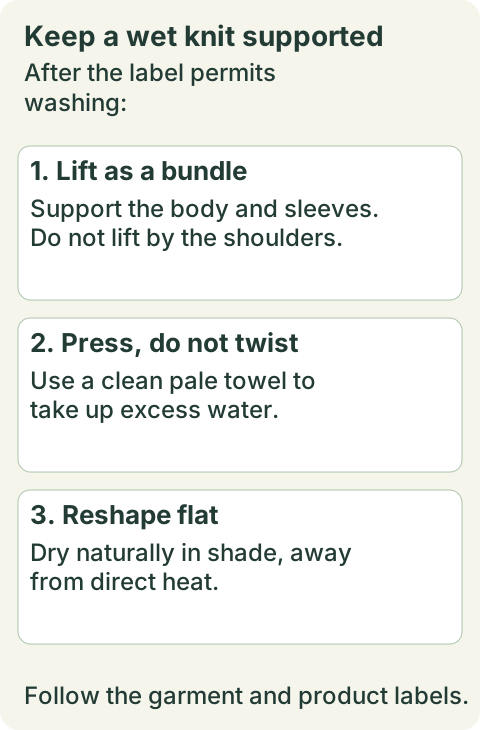
Spread the sweater on a clean pale towel. Arrange the body and sleeves without pulling them longer, then fold or roll the towel around the garment and press gently to absorb water. Unroll it and move it to a dry towel or a suitable flat mesh drying screen. Do not twist the towel into a tight rope or use force to stretch the sweater to a guessed size.
Gently reshape the damp sweater to its normal outline and smooth out folds. For knitwear, Woolmark recommends flat drying unless the care claim specifically permits tumble drying. Keep it away from a radiator, direct heater and direct sunlight, including strong sunlight through glass. Air should be able to circulate; a towel that stays saturated can be exchanged for a dry one.
Drying time depends on the knit, remaining moisture, air movement and room conditions. A fixed “ready in an hour” promise would be misleading. Check thicker areas such as cuffs and seams before putting the sweater away. Store it only when fully dry. A flat shape that looks right while damp does not establish that all moisture has left the garment.
6. Resolve the actual problem before adding another treatment
| Observation | Next decision | Avoid |
|---|---|---|
| Water is strongly coloured | Keep the garment separate and seek maker advice if colour transfer continues. | Adding other light garments or treating a small test as proof for the whole knit. |
| Rinse remains soapy | Use fresh rinse water with gentle supported handling; check the dose next time. | Twisting the sweater to force detergent out. |
| A sleeve looks stretched while wet | Lay it supported and reshape gently without pulling. | Hanging by the cuffs or forcing it to an invented measurement. |
| A stain remains | Ask for a wool-compatible treatment for the exact stain and garment. | Copying bleach or enzyme advice intended for other fabrics. |
| The towel stays wet | Use a dry towel or suitable mesh screen and allow natural drying. | A radiator, direct heater or an unpermitted tumble cycle. |
Shrinkage and stretching are not interchangeable. A sweater that has changed size or texture may need garment-specific assessment. This guide does not promise to reverse a felted knit with conditioner, vinegar or forceful stretching. If the item is valuable, stop repeated washing and document the care label, product and method used before seeking advice.
For next time, keep a simple care note with the garment: permitted method, water instruction, detergent dose and drying place. The printable checks help you practise those decisions. They do not replace the label. Preventing an accidental wrong cycle is often easier when you separate the sweater from a mixed load before laundry starts.
Check your next step
Care check 1: The tag says dry clean only. Is a wool detergent enough to proceed?
No. The detergent describes product suitability, not permission to water-wash the finished sweater. Keep it out of the basin and ask the maker or a professional cleaner for garment-specific advice.
Care check 2: The detergent is gentle on skin and contains enzymes. Is it a wool wash?
Not necessarily. Skin-fragrance claims do not establish wool suitability. Woolmark advises a mild, neutral wool detergent and avoiding heavy-duty, enzyme-containing and bleach-containing detergents. Read the actual product directions.
Care check 3: The sweater feels heavy when wet. Should I hold one shoulder to drain it?
No. Support the body and sleeves together. A wet knit can stretch under its own weight. Press gently, use a towel, then place it flat rather than suspending it by a narrow part.
Care check 4: The rinse water still feels soapy. Should I wring harder?
No. More twisting does not rinse detergent out safely. Use fresh water and gentle supported handling, following the product and garment directions. Wringing adds distortion without solving the dosing mistake.
Care check 5: The sweater is still damp at bedtime. Is a radiator a safe shortcut?
No. Woolmark advises natural drying away from direct heat and sunlight. Keep it supported flat with air circulation and allow more drying time; change a saturated towel when needed.
Download the printable care checks and answer sheet
Sources and garment-specific limits
- Woolmark: how to wash a wool sweater — Care-label permission; lukewarm hand washing, a ten-minute soak in its method, and rinsing.
- Woolmark: detergent for washing wool — Mild, neutral wool detergent; avoid heavy-duty detergents, enzymes and bleach.
- Woolmark: how to dry wool — Support, reshaping, flat drying of knitwear and avoiding direct heat or sunlight.
- American Cleaning Institute: laundry basics — Sort by care instructions, choose a suitable dose, and store clothes only when fully dry.
These references explain the care decisions used here. Your garment’s label and the chosen product’s directions govern the actual wash. Examples and diagrams are original teaching material; they are not tests of a particular garment or a guarantee against damage.