How to Keep Towels Soft and Absorbent
Keep towel softness and absorbency separate while checking label care, detergent dose, softener coating, load room, rinsing and permitted drying.
A softer feel is not proof of better absorbency. Review the finished towel, measured wash setup, additive history and drying before choosing another product or a harsh reset.
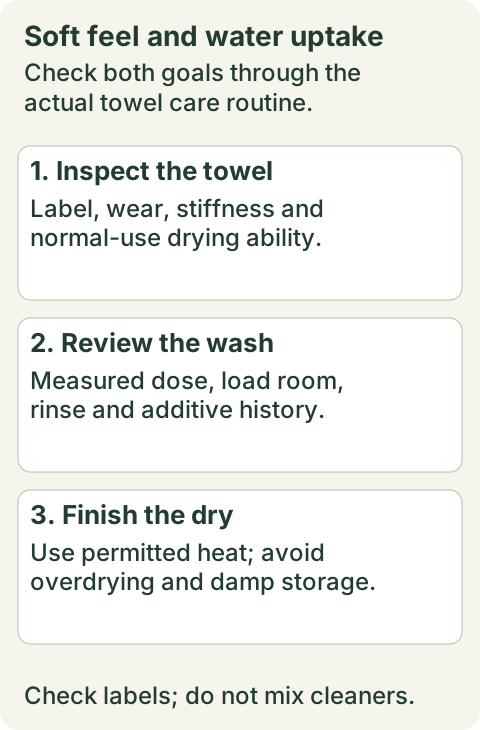
Separate softness from the ability to dry your hands
A towel can feel plush yet absorb poorly, or feel rough while still taking up water. Start by describing both observations. In ordinary use, does the clean dry towel actually dry your hands or leave water smeared on the skin? Does it feel stiff, coated, worn or damaged? This is a practical household observation, not a laboratory absorbency test.
Record the towel’s label and age or wear, the wash setup, detergent amount, additives and drying method. Compare its normal use after suitable care rather than promising a measured absorption percentage. Construction and existing condition can matter, so one rough-feeling towel does not prove that all towels need the same chemical treatment.
Whirlpool warns that fabric softener or dryer sheets can affect absorbency by leaving a coating. Its guide also discusses detergent residue and overdrying as contributors to stiffness. These are useful variables to review, not proof that every stiff towel has one cause or that a single wash can make an old towel new again.
Read the towel label and separate incompatible loads
Check the finished towel’s washing and drying directions before changing temperature, bleach or additives. A decorative border, trim, color or special construction can change care needs. A fiber name such as cotton does not establish permission for every hot cycle or high-heat dry. If the label is missing, seek the maker’s guidance before an aggressive “reset.”
Whirlpool recommends checking the care tag first, sorting colors and loading towels loosely. Keep incompatible garment care out of the load rather than inventing one cycle for heavy towels and delicate clothing. Use the washer’s actual load guidance; a fixed towel count does not fit every capacity or towel size.
New towels should receive the care recommended before first use. Whirlpool discusses washing new towels to reduce lint and remove coatings, but this does not justify adding unapproved bleach or using a sanitizing cycle on every decorated towel. Set a suitable wash and a separately permitted drying plan before loading.
Review detergent amount, crowding and rinsing
| Observation | What to review | Useful correction |
|---|---|---|
| Stiff or coated feel | Measured detergent, concentration and additive history | Follow product dose and a suitable permitted rinse. |
| Poor water uptake after softener | Softener or dryer-sheet use | Review coating-related additives; avoid assuming more softness means better uptake. |
| Poor results in crowded loads | Washer capacity and movement | Use a load with room to wash and rinse. |
| Roughness after extended drying | Permitted heat and drying duration | Avoid unneeded heat or time beyond complete drying. |
| Mustiness after storage | Dense damp edges, folds and cupboard conditions | Dry completely; address the separate odor pattern. |
Read the actual detergent dose for the load and water conditions, including concentration and washer requirements. One capful is not a universal amount. More detergent is not automatically more cleaning, and less detergent is not always a complete fix. ACI and Tide identify multiple wash variables, including amount, soil, water conditions and crowding.
If there is obvious residue or excess suds, check the product and machine directions for an appropriate rinse and correct the next load’s setup. Do not pour an acid, booster or another cleaner into the machine as an improvised response. A rinse setting is a machine instruction, not permission to combine products. Keep the corrected dose in your towel-care note.
Avoid treating fabric softener as an absorbency repair
When absorbency is the goal, review whether fabric softener or dryer sheets are part of the routine. Whirlpool explains that their coating can make towels repel rather than soak up water. Follow the towel’s instructions and consider a suitable wash without a coating-related additive instead of adding more to make the towel feel softer.
Do not replace one automatic additive with a universal vinegar, baking-soda or bleach recipe. The appliance and product directions still apply, and bleach must not be mixed with acids, ammonia or other cleaners. This guide does not copy Whirlpool’s generalized half-cup suggestions into a rule for every towel, product concentration or machine.
Bleach or disinfection is a different task from softness and water uptake. If a towel label permits a bleach for a specific stain or hygiene purpose, follow all relevant directions for that purpose. A softer feel or improved ordinary drying performance is not evidence that the towel has been disinfected. Keep the actual problem clear when choosing any product.
Dry completely with the permitted heat and avoid overdrying
Unload promptly after washing and prepare the towel for its permitted drying method. When tumble drying is allowed, follow the towel label and dryer instructions for the appropriate setting. Whirlpool’s detailed guidance warns that high heat and overdrying can damage fabric, despite broad high-heat wording elsewhere on its page. The specific care permission controls.
Stop unnecessary drying time once the towel is completely dry. Check thick hems, borders and folded areas rather than judging only the warm thin center. If natural drying is required or chosen within the label limits, use a suitable arrangement with room for the towel to dry. Do not substitute a radiator or extreme heat because a towel is taking longer than expected.
Store only fully dry towels in a suitable dry place, and spread used towels so they can dry between uses. Damp storage creates a separate mustiness problem. The musty-towel guide handles that pattern without confusing it with an absorbency repair or promising that dryer heat sets all odors.
Reassess normal use and keep a repeatable care note
After a suitable wash and complete drying, record how the towel feels and whether it performs its ordinary drying job better. Use the same kind of normal-use observation as before. Do not claim a percentage improvement, a removed chemical or a controlled test result from a casual household comparison. The note helps choose the next care question, not prove a mechanism.
If the result improves, keep the successful label-led dose, load, additive decision and drying setup. If the towel remains poor, review visible wear and ask the maker about its construction or remaining care options. Consider replacement when it is worn, damaged or still unsuitable after appropriate care. No cleaning process can guarantee hotel-like softness or restore every old towel.
If many freshly washed items feel coated, inspect the whole wash setup. If the washer itself has routine odor, use its model-specific maintenance process. These are different tasks from local stain removal. The printable checks below help retain the observations and avoid repeating a stain-finder routine on a towel whose actual problem is dose, coating, drying or wear.
Check your next step
Fit check 1: A towel feels very soft after scented fabric softener but smears water rather than drying well. What is the useful distinction?
Soft feel and absorbency are different goals. Whirlpool warns that fabric softener or dryer-sheet coating can affect water uptake. Review the additive history and use a suitable label-led wash and dry without treating more softener as the answer. A home observation does not prove a particular residue or guarantee full restoration.
Fit check 2: You always use two capfuls because towels are thick. What should you check first?
Read the actual detergent concentration and labeled dose for the load, soil and water conditions. Check the washer’s load guidance and allow movement. Thick towels do not create one universal capful rule. Both dosing and crowding can affect laundering; correct the documented setup rather than automatically adding more product.
Fit check 3: The towel has a decorative border and its label requires limited drying heat. Does generic towel advice permit high heat?
No. Follow the finished towel’s care label. Whirlpool’s detailed steps also qualify drying by fabric-safe heat and warn about damage from high heat and overdrying. A broad recommendation for ordinary towels does not override a border or finish restriction on your item.
Fit check 4: The center feels dry, but a folded edge is damp. Should it go into the cupboard?
Finish drying using the permitted method and check the dense edges and folds. Store only when completely dry. A warm center does not prove the whole towel is dry. Damp storage can create a separate mustiness problem, which should not be confused with softness or absorbency.
Fit check 5: The towel has obvious worn, damaged areas and remains poor after suitable care. Should a recipe promise to make it like new?
No. Document its condition and ask the maker about the specific item. A wash cannot guarantee restoration of worn or damaged fabric. Consider replacement if it no longer performs adequately after appropriate care. Do not keep escalating with bleach, acids or extreme heat to chase a promised hotel-soft result.
Download the printable comparison checklist and answer sheet
Sources and limits
- Whirlpool: how to wash and dry towels — Care-tag priority, loose loads, residue, softener coating and fabric-safe drying.
- ACI laundry basics — Dose, compatible care and completely dry storage.
- ACI laundering problems and solutions — Poor laundering and residue can have multiple causes; wear or damage is not guaranteed reversible.
- Tide: how much detergent to use — Label dose, concentration-related measurement, load conditions and crowding.
This guide uses the specific points described beside each source. Your item’s care label, the chosen product’s directions and the exact machine manual govern the work. Product labels, fabric feel and normal-use observations do not establish a diagnosis or prove disinfection. Diagrams and practice cases are original teaching material, not reports of laboratory or product testing.