Practical guide
How to Choose and Use Mesh Laundry Bags
Choose a mesh laundry bag after checking the garment’s complete care instructions. Match its size and shape to the actual item, check the mesh and zipper, and keep the contents loose. Sort the whole load for compatible color and care requirements, use the permitted washer settings, and plan drying separately. The bag helps contain and protect suitable items; it does not supply missing permission to machine wash.
Start with the garment, before choosing a bag
A useful mesh laundry bag fits a permitted washing task. First read the whole garment label, including washing, drying and restrictions. Then check the bag instructions and your washer’s use-and-care guide. If these do not agree, resolve the question before the garment enters the drum.
Whirlpool’s Delicate-cycle preparation guide says to skip machine washing for items tagged Hand Wash Only or Dry Clean Only. Its Hand Wash versus Delicate comparison distinguishes a machine setting from physical hand washing. A mesh enclosure does not remove the movement, water exposure or other effects of the chosen process.
If the tag is missing, use the missing-care-label checklist to recover instructions for the exact finished garment. Its lining, trim, padding and alterations can matter as well as the outer fabric. The shopping question comes after the care question: buying a bag does not resolve an unidentified component.
Match garments to a bag and a compatible process
| Item or situation | Bag choice | Preparation and fit check | Keep this limit |
|---|---|---|---|
| Small machine-washable socks | A suitable mesh bag that retains the items | Group only items with compatible color, soil and care requirements; leave them loose. | Keeping them together does not change their wash or drying instructions. |
| Machine-washable hosiery or lace | A smooth bag whose openings and seams do not catch the fabric | Check the actual item and bag instructions; avoid sharp fasteners in the same bag. | A bag does not repair a snag or approve hand-wash-only material for a machine. |
| A machine-washable bra | A bag whose stated use and shape fit that bra without crushing it | Fasten the garment’s clasps and check that its cup and band fit comfortably. | Underwire, padding and garment instructions still control the method. |
| A small machine-washable top | A bag with room for that top in a loose arrangement | Choose a size using its actual bulk, rather than the clothing size letter alone. | One bag advertised as large is not guaranteed to fit every large top. |
| A permitted machine-wash item with cords | A suitable bag after the item is prepared | Fasten closures and arrange or tie drawstrings as the garment instructions allow. | Do not use the bag to excuse a loose cord or incompatible trim. |
| A hand-wash-only sweater | Keep it out of the machine load | Follow the hand-washing and drying instructions; use a suitable assessment if they are missing. | A mesh enclosure does not change the washer’s movement into physical hand washing. |
| A dry-clean-only or unidentified garment | Do not choose a machine bag as the solution | Recover the complete care instructions or seek an appropriate assessment. | Cold water and a gentle cycle do not supply missing care permission. |
| A bulky item that strains the zipper | Reduce the contents or choose another suitable size or method | Follow any stated bag capacity and washer limits; do not compress it just to close the bag. | There is no universal item count or fill percentage established for every mesh bag. |
The rows are decision examples, rather than approvals for every garment in a category. A silk-looking blouse, a padded bra and two different sweaters can have different instructions. Use the table only after checking the actual item. A bag’s intended use is another requirement, not evidence that every possible fabric is suitable.
Small-item containment can be a worthwhile reason to use a bag even when the fabric is sturdy. Conversely, a large or fragile item can remain unsuitable for a particular bag even when it is machine washable. The relevant questions are compatibility, physical fit and the process you will actually use.
Choose size using dimensions and the item’s bulk
Read the bag’s actual dimensions instead of relying on small, medium or large. Check whether the listing describes a flat rectangle, a shaped bag or another construction. The garment’s size letter does not tell you its folded bulk, and a bag dimension is not a guaranteed number of garments.
For a concrete specification example, Brabantia’s described three-bag set lists two 33 × 25 cm bags and one 45 × 33 cm bag. It also describes a zipper with a pull-tab cover. Those are specifications for that product, not universal laundry-bag sizes or a claim that we tested its capacity. Another maker’s large bag may have different dimensions or shape.
Place a suitable garment loosely in the bag before committing to the load. Do not compress a thick bundle just to make the zipper close. Check any stated capacity or loading guidance first. If the contents strain the opening, reduce them or choose another suitable size or care method. A bigger bag also has to fit the intended washer load; it does not expand the machine’s capacity.
A loose-fit check before the bag enters the washer
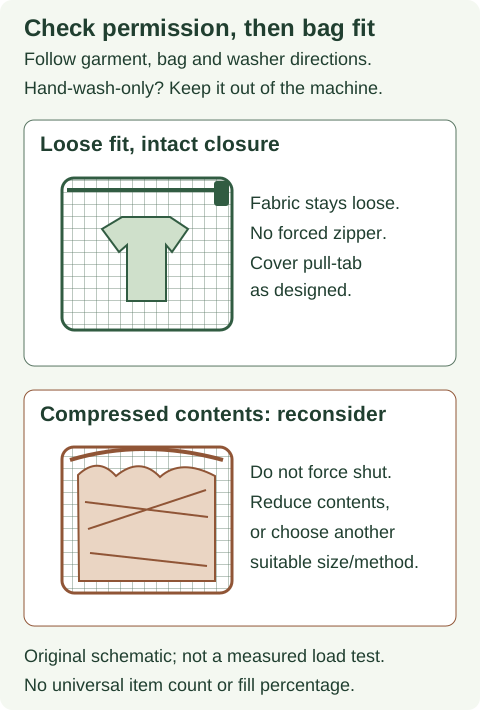
The useful observation is whether the item remains loosely arranged and the closure operates normally. A bag that closes only under pressure is a reason to reconsider, not a successful capacity test. Do not turn the empty area in this drawing into a numerical loading rule: fabrics, construction, bag shapes and maker instructions differ.
ACI’s Laundry Basics advises leaving clothes room to move and not overloading the washer. Apply the whole-load instruction as well as the bag check. Several acceptable small bags can still be part of an overloaded or badly sorted drum. If your washer specifies a particular loading arrangement, follow that model’s guide.
Inspect the mesh, seams, shape and zipper
Look for intact mesh and smooth seams, and check that the fabric does not catch on a rough area. The opening should be suited to the items you want to retain. A finer-looking mesh is not, by appearance alone, proof of better cleaning or longer life. This guide does not rank pore sizes or claim measured differences between products.
Operate the zipper while the bag is empty, then check it with suitable contents. It should close without trapping fabric or needing force. If the bag includes a pull-tab cover or another closure feature, use it as the maker describes. Brabantia explains that its cover is intended to protect other laundry and the washing machine; that is the maker’s description of the feature, not an independent durability test.
Prepare the garment’s own hardware too. Whirlpool’s steps include fastening zippers and bra clasps and arranging drawstrings to reduce catching or tangling. A bag closure and an open garment clasp are different things. Avoid putting an exposed sharp closure beside delicate fabric and assuming the outer mesh makes the combination suitable.
Set aside a torn bag, separating seam or rough, broken zipper. Follow the maker’s repair or replacement guidance rather than improvising pins or tight knots. For a shaped bag, check that the garment fits its intended shape without forcing padding or cups into an unsuitable position.
Sort first, then prepare the bags and the whole load
- Group compatible items. ACI recommends sorting for color, fabric-care instructions and soil. Separate incompatible items even if they would be in different bags.
- Prepare the garments. Empty pockets and fasten closures. Turn items inside out when the garment guidance and proposed process make that appropriate.
- Check each bag. Inspect the mesh, seams and zipper; choose its appropriate size and arrange the contents loosely.
- Close it as designed. Keep fabric out of the zipper and use a supplied pull-tab cover correctly.
- Load the washer appropriately. Bagged items still count as part of the whole load. Follow the machine’s loading limits and the garment-compatible cycle.
- Dispense detergent correctly. Use the product’s directions and the washer’s dispenser instructions for the actual load.
- Unload and inspect. Account for small items, inspect the contents and bag, and continue with the permitted drying method.
A bag does not isolate colors from shared wash water. Nor is a separate dose needed inside each bag. ACI and Whirlpool both advise following detergent directions; washer type, load size and soil can affect dosage. Do not add extra product just because some of the clothes are enclosed in mesh.
Whirlpool recommends separating delicate items from heavier fabrics such as towels or denim. Do not put a lightly soiled, fragile item into a heavy-duty load solely because its bag is sturdy. The cycle, overall load and complete garment instructions remain part of the choice.
Plan drying and look after the bag
Read drying instructions separately from washing instructions. A garment may need flat drying, hanging, a particular tumble setting or another process. Remove and arrange it as that method requires, giving a wet knit suitable support where its care guidance calls for it. Washing in a bag does not authorize drying the garment inside that bag.
Check the bag maker’s own dryer and care directions too. A garment’s low-heat tumble permission is not evidence of the bag’s heat compatibility. Likewise, a mesh accessory does not turn a do-not-tumble-dry instruction into a safe dryer setting. If the needed bag information is absent, do not fill it in from another product’s listing.
After use, inspect the mesh, seams and closure, and follow the maker’s cleaning and drying directions before storing the bag. Remove retained items or loose debris rather than leaving them for the next load. Keep a damaged bag out of use until its condition is addressed. The useful routine is a short check before reuse, not an invented replacement schedule for all bags.
If the contents remain soapy or tightly bundled, review fit, loading, cycle and detergent use before repeating a stronger treatment. Residue alone does not establish one cause. Choose the next rinse or wash only within the garment’s permitted care and the machine’s instructions.
Eight practical decisions with explanations
These invented situations show how to apply the matching table. Make your own decision before opening each explanation. They describe care and fit choices, not results of product tests or washes performed by this site.
Case 1
You have two pairs of small socks with compatible care labels. They move loosely in an intact bag. What does the bag change?
Show answer and explanation for case 1
It can keep the small items together; their label, sorting, washer and drying requirements still apply.
ACI recommends mesh bags for small or delicate items and advises sorting by care requirements, color and soil. The bag is useful for containment, but it is not a separate wash environment. Do not put a new dark sock with pale items merely because the dark sock is inside mesh. Use the permitted settings and a detergent dose for the whole load. After washing, account for the items and follow their drying instructions. This invented example does not promise a measured reduction in lost socks.
Case 2
A blouse is labelled hand wash only. Would placing it in a bag make the Delicate cycle an approved substitute?
Show answer and explanation for case 2
No. Keep it out of the machine load and follow its complete hand-wash instructions.
Whirlpool’s preparation steps say to skip the machine when the tag says Hand Wash Only or Dry Clean Only. Its separate cycle article also distinguishes a machine’s Hand Wash setting from washing physically by hand. Mesh can reduce some contact and contain small items, but the garment still undergoes the chosen machine process. The presence of a bag supplies no new care instruction. If the label is incomplete, use the missing-label checklist to recover information before deciding on the full washing and drying process.
Case 3
A bag called large closes only when you push a permitted top into a tight bundle. Is the successful zipper closure enough?
Show answer and explanation for case 3
No. Reconsider the fit rather than using closure as proof of a suitable load.
The bag’s marketing size name is not an item-capacity guarantee. Read any maker load guidance, check the actual dimensions and consider the garment’s bulk. A loose-fit check leaves the fabric uncompressed and does not require force at the zipper. If the bag is unsuitable, choose another appropriate size, reduce the contents, or use another permitted method. The diagram illustrates this difference without assigning a universal half-full rule. ACI’s advice that clothes need room to move also applies to the overall washer load.
Case 4
You have white items and a new dark garment. Can separate mesh bags make them a compatible wash load?
Show answer and explanation for case 4
No. Sort for color and care compatibility before using bags.
A mesh bag allows wash water to reach its contents; it is not a sealed color-isolation container. ACI recommends separating whites and paying attention to new, dark or brightly colored items. Use the actual garment guidance and the relevant colorfastness procedure only when the proposed test and wash are suitable. Different bags do not turn shared wash water into separate color-safe loads. The useful decision is to separate incompatible items rather than adding a finer mesh and assuming dye transfer has been prevented.
Case 5
The bag has a zipper cover, but the pull-tab remains exposed and the garment clasp is open. What should you check?
Show answer and explanation for case 5
Prepare the garment’s closures and use the bag’s pull-tab cover as designed.
Whirlpool recommends fastening zippers and bra clasps, and arranging drawstrings to reduce snagging or tangling. Brabantia’s described bag has a special pull-tab cover intended to protect other laundry and the machine. These are two separate checks: garment hardware inside the bag and the bag’s own closure outside. Do not force fabric into the zipper or invent a knot, pin or replacement fastening that the maker does not specify. A broken zipper or torn seam needs attention before the next load.
Case 6
A garment permits low-temperature tumble drying, but you cannot find dryer instructions for its wash bag. Can both go into the dryer together?
Show answer and explanation for case 6
Do not infer dryer compatibility for the bag from the garment’s drying instruction.
Washing and drying permissions are distinct. Check the bag maker’s directions as well as the garment’s complete label. Remove the garment from the bag when its permitted drying process calls for that arrangement, and use the required support or shape. A machine-washable mesh bag is not automatically approved for every dryer temperature, and a bag does not convert a flat-dry instruction into tumble drying. Neither the source product’s marketing description nor the garment’s fabric name establishes the missing bag instruction.
Case 7
The clothes feel soapy after washing. Should you pour extra detergent into the bag next time?
Show answer and explanation for case 7
Review dose, load, bag fit and the permitted rinse process before adding more product.
ACI says to follow detergent directions and notes that more detergent is not necessarily better. Whirlpool also links dosage to the load, washer type and soil level. A separate bag does not create a separate dose requirement. Check whether items were compressed, the washer was overloaded, the selected process was appropriate and the detergent was correctly dispensed. Handle the present residue using a garment-compatible next step. This symptom is not proof of one cause, and the example does not diagnose every washer fault.
Case 8
The bag has a small hole and a rough zipper edge. The garment itself is still machine washable. Is the bag ready to use?
Show answer and explanation for case 8
No. Address the damaged bag before entrusting a delicate item to it.
Inspect the mesh, seams and closure, not just the item’s care label. An opening can fail to retain small items and a rough edge can contact fabric. Follow the maker’s repair or replacement guidance; do not improvise metal pins or ties that could create new catching points. Garment permission establishes that a suitable machine process is allowed, not that a damaged accessory is suitable. Using another appropriate intact bag, or a different permitted care method, is a concrete next action without inventing a tested lifespan.
Download a bag-selection and loading sheet
Download the matching table, prewash checklist and eight cases with answers, or download the original loose-fit diagram. Record the actual bag dimensions, its closure feature, the garment’s complete care instructions and the intended wash and drying process. Leave unresolved instructions marked unknown.
The result should be one usable next action: load suitable items in an appropriate intact bag, choose a better fit, or keep an incompatible garment out of the machine. A price, customer rating or successful zipper closure cannot replace those checks.
Sources and further reading
- American Cleaning Institute: Laundry BasicsSorting by color, care and soil; mesh bags for small or delicate items; washer loading, product-dose and separate care-symbol principles.
- Whirlpool: What Is the Delicate Wash Cycle?Nine garment preparation, mesh-bag, cycle, detergent and drying steps. Model-specific instructions and complete garment care remain controlling.
- Whirlpool: Delicate vs. Hand Wash CycleMachine cycles distinguished from physical hand washing and the instruction not to put hand-wash-only items through a Delicate cycle.
- Brabantia: Wash Bags, set of 3, in 2 sizes, 149221A specific maker’s stated bag dimensions and special zipper pull-tab cover. Listed specifications are an example, not a tested ranking or capacity guarantee.