How to Get Odor Out of Athletic Clothes
Reduce recurring activewear odor by checking garment care, damp bag storage, detergent dose, wash setup and permitted drying, with item-specific limits.
Sportswear does not have one universal care rule. Check the finished garment, the wash setup and the bag/storage routine. Use a specific permitted process instead of a repeated stain-removal recipe.
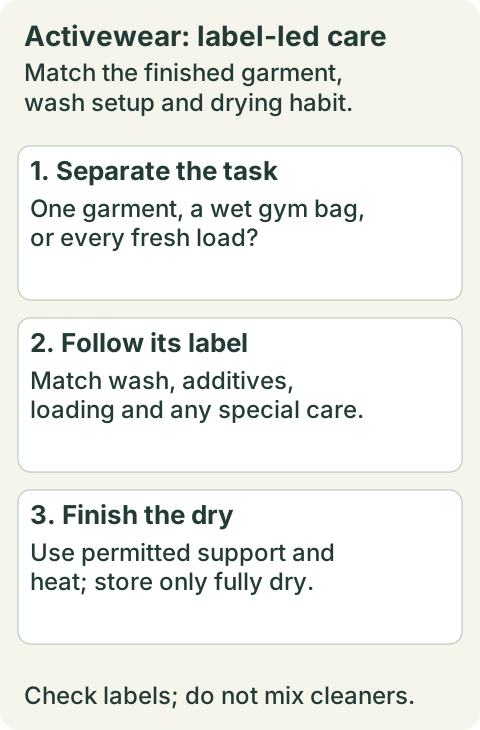
Identify the garment and when odor appears
Activewear is a use category, not one fabric with one washing rule. A training top, compression garment, lined jacket and wool base layer can have different care needs. Read the label on the actual item and note any maker instructions for its finish, printing, lining or stretch construction. Do not infer care permission from the word “performance.”
Check the odor pattern: one item after wearing, garments left damp in a gym bag, or every fresh load immediately after washing. Look for a visible deodorant mark or other stain as a separate observation. These distinctions help decide whether to correct storage, garment care or the wash setup. They do not identify a bacterial species or demonstrate contamination levels.
Record the item, label, product and amount, cycle, load size, unloading delay and drying method. The useful goal is a repeatable process for that garment. This guide does not report laboratory tests comparing sports fabrics or promise that a particular detergent removes all odor in one wash.
Keep used damp gear separate and inspect the storage source
Avoid leaving damp used gear bundled with clean clothing in a closed bag. Arrange used items appropriately until they can be washed, and use a safe drying or airing setup only when their care permits it. Do not force a fragile or heavy wet item onto an unsuitable hanger because a gym-bag checklist says to air clothing.
Review the bag, hamper and storage area if garments regain odor there. Follow the bag’s own care instructions; it may not share the clothing’s washing method. Do not spray unknown disinfectants into a bag as a substitute for suitable cleaning and complete drying. Keep cleaned, dry gear away from a source that has not been addressed.
Storage and washing are related but different decisions. A suitable wash followed by another damp day in the same closed bag can leave the underlying routine unchanged. Conversely, a clean dry bag cannot correct detergent residue or an unsuitable garment cycle. Note when the odor returns to choose the next useful correction.
Match wash, additives and drying to the finished item
| Question | Use this evidence | Do not assume |
|---|---|---|
| What washing method is permitted? | The finished item’s label and maker guidance | All sports fabrics tolerate the same cycle. |
| What temperature is allowed? | The stated limit for this garment | A hotter wash is always the right odor fix. |
| Are additives restricted? | Specific item and product directions | Softener or bleach is always allowed or always forbidden. |
| How should it dry? | Separate drying permission and suitable support | A cool wash permits low-heat tumbling. |
| Why does a whole load smell? | Dose, load, rinsing, machine and storage observations | Every item needs a separate stain recipe. |
If the label or maker restricts fabric softener, bleach or another additive, follow that restriction. Check automatic dosing settings as well as products you add by hand. Do not turn a restriction for one performance garment into a universal statement about every sports item; the practical rule is to use the specific care claim.
Choose a compatible laundry product and read its concentration and dose directions. Some garments require a particular gentle or wool-compatible approach. When a label is unclear, resolve the care question before washing. Product marketing such as “sport” does not create permission to ignore a finished garment’s temperature or drying limits.
Measure detergent and choose a suitable load and cycle
Sort compatible care needs and colors, then give the load room to move and rinse. Follow the washer’s guidance rather than forcing bulky towels and special-care sports items into one crowded load. ACI’s laundry guidance discusses dose, temperature suitability and movement as factors in performance; more items and more detergent do not automatically produce a better wash.
Measure the actual product for its concentration, the load and water conditions specified on the label. A capful from one formula is not the same dose as a capful from another. If automatic dispensers are used, check their configured concentration and product compatibility according to the machine manual. Keep a note of what was actually used.
Use the permitted cycle and finish its rinse. If excess suds or residue is obvious, review dose and load and follow the manual for any appropriate additional rinse. Avoid adding another cleaner midway through the cycle. Never mix bleach with acids, ammonia or other cleaners, and do not use a fixed vinegar or baking-soda sequence as a universal activewear process.
Handle actual stains without converting every odor into a stain
A visible deodorant or perspiration mark may need a separate treatment. ACI’s stain guide treats those marks as specific stains with qualified care instructions. Use a product and method permitted by the garment and the actual stain, including any colorfastness test, application time and rinse directions. A performance finish or delicate trim may limit what is suitable.
Do not automatically scrape, brush or rub the garment with dish soap just because another stain guide uses those actions for a different substance. Odor without a visible mark does not establish a stain that needs those techniques. A mesh bag can help organize a permitted delicate wash, but it does not change the garment’s care limits or guarantee odor removal.
Check a remaining visible mark according to the relevant stain advice before deciding the next permitted drying step. That is different from claiming all odors become permanent under dryer heat. Keep the observations separate: what changed in the mark, what changed in ordinary odor, and whether the item still has an unresolved care or exposure concern.
Unload, dry completely and reassess before storage
Unload the completed wash promptly and follow the item’s separate drying permission. A no-heat tumble cycle is still tumbling; it is not automatically equivalent to natural drying. Use suitable support and positioning for the finished garment, respect limits on heat or sunlight, and avoid stretching a wet knit or special construction.
Check seams, waistbands, padding and folds before storing. ACI advises putting clothing away only when fully dry. Keep clean dry gear apart from used damp items. If drying is consistently difficult, improve the permitted arrangement and timing rather than substituting an unapproved hot dryer or radiator shortcut.
If odor persists on one item after suitable care, ask the maker or an appropriate cleaner about that garment. If whole fresh loads smell, review the washing and drying system and check routine machine odor as appropriate. Do not describe a scented or better-smelling result as disinfection, proven bacterial removal or permanent success. The checklist below keeps the next correction tied to what you observed.
Check your next step
Odor check 1: The same leggings smell after spending a day damp in a zipped gym bag. What changes first?
Separate used damp items from clean gear and avoid repeated damp bundling. Wash the leggings with the care their label permits, then dry completely before storage. Review the bag as a possible recurring storage source. More fragrance or detergent does not correct the same wet-storage pattern.
Odor check 2: A sports top’s maker warns against fabric softener. Does ordinary laundry advice to soften fabrics override that?
No. Follow the finished garment’s specific care instruction. General laundry advice does not override a performance finish or a stated restriction. Check the product and machine settings for automatic dosing too. This does not mean every sports garment has the same prohibition; use the label for your item.
Odor check 3: A garment includes stretch panels and its label allows only a cool wash and natural drying. Can you use hot washing and low-heat tumbling to tackle odor?
Follow the actual wash and drying limits. Low heat is still tumble drying, and a low-temperature wash does not change drying permission. Choose a compatible product and suitable natural drying support. Ask the maker for advice if permitted care does not resolve the issue rather than overriding the restrictions.
Odor check 4: Every sports garment smells immediately after a fresh wash, even without bag storage. Where should you look?
Review detergent concentration and measured dose, compatible cycle, load room, rinsing and accessible machine odor. Treat the whole-load pattern as a wash-system question rather than a separate stain on every garment. Use the after-wash troubleshooting guide and model-specific maintenance when appropriate.
Odor check 5: A visible deodorant mark remains on a training top. Is it enough to follow the odor process repeatedly?
Identify the mark as a separate stain task and use only a treatment permitted for the garment and actual stain. Check colorfastness when instructed and reassess before the next permitted drying step. Do not add bleach or scrub a delicate finish by default. The mark and odor need separate observations.
Download the printable odor checklist and answer sheet
Sources and limits
- ACI laundry basics — Compatible care, measured detergent and full drying.
- ACI laundering problems and solutions — Poor laundering, load movement, residue and fabric-care limits; its old generic heat advice is not applied to restricted modern activewear.
- ACI stain removal guide — Visible deodorant/perspiration marks as separate stain tasks.
- ACI: how to use bleach — Specific garment and product permissions and mixing hazards.
This guide uses the specific points described beside each source. Your item’s care label, the chosen product’s directions and the exact machine manual govern the work. A change in smell does not prove disinfection or safe clearance of fire or chemical contamination. Diagrams and practice cases are original teaching material, not reports of laboratory or product testing.