Best Laundry Detergents for Sensitive Skin
Compare sensitive-skin detergent labels, washer and garment fit, measured dose, rinsing and cost per wash, with clear limits for eczema and allergy concerns.
Compare the exact package against your specific requirements. Check care and dose before price. A detergent comparison cannot diagnose a skin condition or promise one formula will suit everyone.
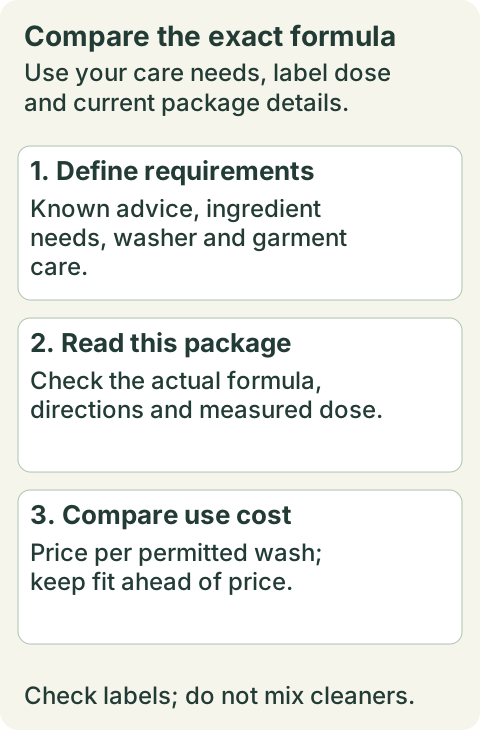
Start with a shortlist of requirements for your household
The best fit is the exact formula you can use correctly for your clothes, washer and personal care needs. Write those requirements before comparing bottle sizes or reviews. If a clinician has advised avoiding a particular ingredient or additive, carry that specific advice into the comparison. “Sensitive skin” describes a broad concern; it is not a diagnosis or a single formula that works for everyone.
Check the current package rather than assuming a familiar brand always has the same ingredients, scent or dose in every version. Note the full product name, concentration or format, washer compatibility and directions. If the information you need is absent, ask the manufacturer instead of guessing from color, price or popularity.
For children with eczema, the American Academy of Dermatology says a detergent made for sensitive skin may be beneficial and recommends the correct amount and adequate rinsing. Its page is child-eczema guidance, not a clinical comparison of every detergent or evidence that an adult’s symptoms have one cause. Use it within that scope.
Compare five concrete features on the current package
| Feature | What to record or confirm | Reason to pause |
|---|---|---|
| Your specific care requirement | Exact fragrance, dye or ingredient information relevant to advice you have received | The claim does not answer your actual requirement. |
| Washer and garment fit | HE/washer requirements, fabric compatibility and special-care limits | Either the machine or finished garment prohibits the method. |
| Dose clarity | Concentration, load/soil/water guidance and measuring instructions | You cannot determine the permitted amount. |
| Rinsing and other additives | Suitable cycle and whether scented softener or dryer sheets are also being used | The detergent changes but the rest of the exposure routine is ignored. |
| Cost of equivalent use | Current price, net amount and label dose for the same conditions | Only bottle price or advertised wash count is compared. |
A word such as “sensitive” or “hypoallergenic” is not a substitute for the specific information you need. Read the actual ingredient or manufacturer information where available and identify any unresolved question. This guide does not assign an allergy-safety score to a marketing word or treat a front-label claim as a guarantee for every person.
If your care advice requires fragrance avoidance, look for an explicit statement that addresses that requirement and confirm uncertain information with the maker. Do not infer the formula from how the product smells, its packaging color or a review saying it is mild. If dyes or another ingredient matter to your personal advice, check those separately.
Choose a format you can measure and store appropriately
Liquid, powder and packet formats have different use directions and measuring arrangements. Choose according to the actual package, washer instructions and garment requirements. A format name alone does not establish suitability for sensitive skin, cleaning performance or a universal number of washes. Check that you can use the product as directed in your routine.
For a liquid, read the concentration and cap or dispenser instructions. A line on one cap is not the same amount as a line on another. For powder, follow the stated measure and the machine’s instructions. For a packet, follow the package’s whole-product dosing directions rather than improvising a fraction or transferring instructions from a liquid.
Store laundry products as their labels require, securely away from children and pets and in appropriate packaging. Plan measurement before the wash so you do not pour by habit. If an automatic dispenser is used, configure the actual concentration and product compatibility according to the washer manual. A different bottle can need a different dispenser setting.
Use the recommended amount and a suitable rinse
The AAD’s child-eczema clothes-washing tips recommend only the suggested amount of detergent and enough water for adequate rinsing. For a household washer, implement that through the compatible product dose, load and cycle instructions. Do not manually add water to an appliance or override its controls because a general health page mentions rinsing.
Tide’s dosing guide identifies soil, load size and water hardness as relevant conditions and directs readers to the package. It also explains that crowded loads can leave too little free water for satisfactory laundering. White residue is therefore not a reliable diagnosis of one cause. Check dose, concentration, load room and cycle together.
Do not automatically halve the dose for every person with sensitive skin or double it for every dirty item. Follow the actual directions and care needs. If residue or excessive suds is evident, correct the documented wash setup and use any appropriate rinse described in the manual. Buying another formula without checking the setup can leave the same avoidable problem.
Check the whole laundry routine and respect health limits
Detergent is only one product used around clothing. The AAD child-eczema page notes that scented fabric softener or dryer sheets may contribute to irritation. Record these additives as part of the routine, including automatic dosing and products used in drying. Changing the detergent while overlooking another scented product may not answer the original question.
The same AAD resource recommends washing a child’s new clothes before wearing to remove excess dyes and fabric finishers. Follow each garment’s care label when doing so. A special-care garment may need a separate method, and the recommendation does not authorize a universal hot wash, bleach treatment or unsuitable dryer cycle.
If itching, rash or another persistent skin concern is present, seek appropriate health advice. Do not conclude that detergent is the cause from a single laundry observation, put concentrated detergent on skin as a test, or deliberately challenge a known allergy. The comparison sheet organizes product and wash information that may help you explain the routine; it does not diagnose or treat eczema.
Compare cost per label-directed wash after confirming fit
Use the detergent cost-per-load calculator with the current price, net amount and actual labeled dose. Keep the same units and equivalent load conditions. Advertised wash counts may reflect different assumptions from your household dose, so record how the number was obtained. Cost is useful only after the product and method satisfy the care requirements.
For a fictional illustration, suppose option A costs $12 for 1,000 mL and its dose for the comparison load is 25 mL. That is 40 washes, or $0.30 per wash. Option B costs $15 for 1,500 mL with a 50 mL dose: 30 washes, or $0.50 per wash. B costs less per milliliter but more per wash in this example. These are arithmetic examples, not checked product prices or cleaning tests.
Do not lower either dose to produce a preferred answer. Enter the amount required for your actual conditions and note any uncertainty. Once you have a compatible choice, retain the full formula name, dose and settings. Recheck directions when the package or concentration changes. The printable comparison sheet below keeps the formula and use-cost questions distinct.
Check your next step
Fit check 1: A bottle says “sensitive” but does not explain the formula details you need. Is that enough to choose it?
Read the exact current package and available manufacturer information. Check the particular fragrance, dye or ingredient requirement you have been advised to follow, as well as washer and garment compatibility. A broad front-label word does not answer a specific ingredient question. Ask the maker if the relevant information is missing.
Fit check 2: You have child eczema advice but assume any flare-up proves a detergent allergy. What is the right boundary?
Eczema is not automatically proof of a detergent allergy. The AAD child-eczema resource says most children’s eczema does not have a clear cause such as an allergy. Use the clinician’s care advice and the recommended wash dose and rinsing. Persistent or worsening symptoms need appropriate health advice rather than repeated detergent experiments.
Fit check 3: A larger bottle costs less per milliliter but needs a larger labeled dose. Is it necessarily cheaper per wash?
No. Compare price divided by the number of equivalent label-directed washes, using the actual dose for your conditions. Concentration and dose can change the result. Keep garment, washer and personal requirements satisfied first; reducing the dose below directions to make a price look better is not a valid comparison.
Fit check 4: There is residue on several items. Should you immediately blame the detergent formula and switch brands?
Review the documented dose, load size, concentration setting, cycle and rinsing. Tide notes that both dose errors and overcrowding can contribute to poor results. Follow the washer and product instructions before attributing the problem to one ingredient. Residue alone does not diagnose an allergy.
Fit check 5: You want to test the detergent by applying it directly to your skin. Should this guide recommend that?
No. Laundry detergent is for use according to its product directions, not a home skin test. Do not deliberately challenge a known allergy or put concentrated detergent on skin. If a skin reaction or ingredient concern is involved, seek appropriate clinical advice and follow the product’s exposure instructions.
Download the printable comparison checklist and answer sheet
Sources and limits
- AAD: child eczema care and clothes-washing tips — Detergent made for sensitive skin may help; use recommended amount, adequate rinsing and clinician advice. This is child-eczema guidance.
- Tide: how much detergent to use — Package dose, soil, load size, water conditions and crowding; manufacturer advice is not an independent sensitive-skin product test.
- ACI laundry basics — Product directions, garment care, compatible washing and drying.
- ACI laundering problems and solutions — Poor laundering and residue can involve multiple setup variables; no ingredient allergy diagnosis is inferred.
This guide uses the specific points described beside each source. Your item’s care label, the chosen product’s directions and the exact machine manual govern the work. Product labels, fabric feel and normal-use observations do not establish a diagnosis or prove disinfection. Diagrams and practice cases are original teaching material, not reports of laboratory or product testing.