Practical guide
How to Clean Cambria Quartz Without Adding a Sealer or Abrasive
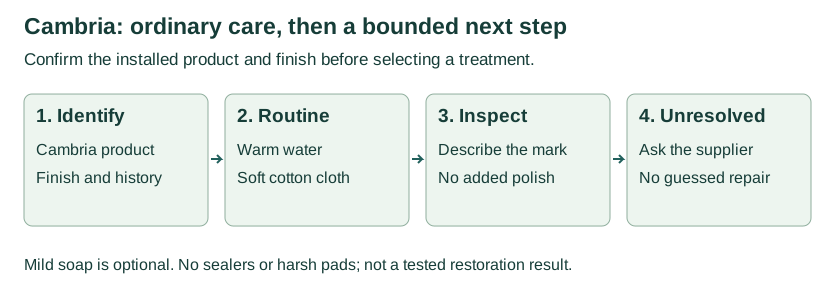
For an identified Cambria quartz counter, start with warm water and a soft cotton cloth; mild soap is optional. Do not add a sealer, polish or abrasive pad to chase a mark. Cambria’s care directions distinguish normal surface residue from damage and say its product never needs sealing, polishing or reconditioning. A persistent finish change needs advice for the installed product.
Confirm Cambria and the installed finish
A stone-like pattern does not identify the product. Check an invoice, installer record, supplier reply or other reliable product information. Record whether the installed finish is Cambria Matte or another documented finish, and whether anyone has already applied a coating, polish or treatment.
This guide concerns Cambria quartz, using its current US product-care page. It does not supply permissions for natural quartzite, marble, another quartz brand or every matte worktop. If the identity is missing, recover it before choosing a special treatment. The natural-stone acid guide explains why a stone name and a sealer are separate questions.
Use the documented routine before changing products
Cambria names warm water and a soft cotton cloth, with mild soap if desired. It also states that its quartz counters are nonporous and nonabsorbent and do not require sealing, polishing or reconditioning. Those claims support a simple care route; they do not mean the product is chemical-proof, heat-proof or fracture-proof. [1]
- Confirm the product and finish, and note any existing chips or changed areas.
- Use a clean soft cotton cloth with warm water. If using mild soap, follow the actual soap’s directions and the counter’s restrictions; do not invent a bucket ratio.
- Work on the ordinary residue without changing to a harsh pad or added treatment.
- Complete any removal-of-residue instructions that apply to the soap. Use clean water and a clean cloth rather than leaving an added product on the surface.
- Inspect the visible result after the surface has dried. Record what remains; a temporary wet shine is not evidence that the original finish has been restored.
The first two material/tool choices come from the maker. The record and inspection steps help you describe the outcome; this site has not performed a cleaning trial on your counter.
Distinguish a care task from a finish or damage question
Scroll the table sideways on a phone. Keyboard readers can focus its region and use the arrow keys.
| What you know | Useful next action | Avoid assuming |
|---|---|---|
| Ordinary residue on confirmed Cambria | Use the warm-water, soft-cotton route, with mild soap if desired. | A stronger cleaner is needed before routine care. |
| Normal markings on confirmed Cambria Matte | Use the same documented washing route. Matte is not intended to shine. | A shiny polish restores the correct Matte appearance. |
| Dull or uneven gloss after an added treatment | Record that treatment and ask Cambria or the supplier about the actual finish. | More treatment or abrasion reverses the change. |
| A chip, persistent changed area or unknown chemical exposure | Stop escalating and request product-specific assessment. | A visual description proves the cause or a cleaning remedy. |
The maker says Cambria Matte can show normal-use markings and describes removing them with warm water and a soft cotton cloth, with mild soap if desired. It also says Matte does not shine. That is an important expectation: gloss is not the success criterion for a deliberately matte finish. [1]
The labelled diagram keeps its reading size; scroll it sideways on a phone.
Keep sealers and abrasive shortcuts out of the routine
Cambria prohibits abrasive or harsh scrub pads and applying sealers, penetrants or topical treatments. It explains that these added products can wear off and make gloss look dull or inconsistent. A product marketed as a stone sealer is therefore not a maintenance upgrade for this counter. [1]
The same care page warns against abrasive, strong alkaline, acid, oxidizing and similar cleaners. Its named exclusions include bleach, oven cleaner, Comet, Soft Scrub, S.O.S. pads and products containing pumice. The list is not exhaustive. A neutral-pH label alone does not cancel the maker’s other chemical and abrasion restrictions. [1]
Do not use a hidden patch to turn a prohibited product into an approved one. If a cleaner’s suitability is unclear, ask about that exact product and the installed finish. Keep cleaners separate and use their own precautions. A method described for FENIX matte material is not Cambria permission.
Protect the surface during normal kitchen use
Cambria recommends a cutting board. It warns that objects striking edges around sinks and dishwashers can cause chips, and that surface markings may show more on monotone designs. A countertop’s durability is not permission to cut directly on it or strike its edge. [1]
Use the maker-described closed-weave hot pad or solid trivet under hot cookware and countertop cooking units. Its care page includes slow cookers, air fryers and griddles among heat sources; rapid temperature changes or sustained direct heating can damage the surface. Check the appliance’s placement instructions as well. No temperature limit or universal trivet thickness is inferred here. [1]
Try three original care decisions
These constructed cases test which instructions apply. They are not reports of cleaning performance.
Case 1
A confirmed Cambria Matte counter looks flat after routine cleaning. Should the owner add a stone polish to make it shine?
Show answer and explanation for case 1
No. Keep the intended Matte finish and the no-polish rule together.
Cambria states that Matte does not shine and that its counters need no polishing. A gloss-restoration goal changes the product’s intended appearance rather than proving a cleaning need.
Case 2
An owner has normal residue on identified Cambria. A friend suggests a hard scouring pad because their different counter tolerated it. Is that evidence for this one?
Show answer and explanation for case 2
No. Use Cambria’s permitted cloth route.
The maker prohibits abrasive or harsh pads. Another material and another person’s experience do not override that restriction.
Case 3
Uneven gloss appeared after an added sealer. Can another cleaning pass prove whether the surface is damaged?
Show answer and explanation for case 3
No. Record the sealer and obtain advice about the finish.
The care page warns that topical products can produce dull or inconsistent gloss, but appearance alone cannot diagnose this installation or establish a removal procedure.
Keep the product care information with the counter
Download the blank countertop-care record. Fill it with the installed product and the exact instructions you have checked. Keep an unresolved condition marked as unresolved.
For Cambria, record the material and finish, supplier confirmation, cleaner name and label, cloth or pad, the known spill, steps already taken, and the appearance after the permitted rinse and drying process. If you ask the supplier for help, this record gives them the actual question rather than an assumed diagnosis.
Sources and further reading
- Cambria: Quartz Product CareManufacturer directions for routine care, prohibited treatments and cleaners, Matte finish, heat and edge protection.