Practical guide
How to Clean FENIX Matte Surfaces Without Creating Shiny Spots
First confirm that the surface is FENIX. Its matte appearance comes from a particular surface structure, so regular rinsing and drying matter as well as removing a spill. Formica’s FENIX instructions discourage abrasive cream, scouring pads and hard brushes, which can lead to glossy spots over time. A wet melamine eraser is described for FENIX; it is not permission for every matte counter.
Check the product, not just the matte appearance
Formica explicitly says to verify that the matte surface is FENIX before following its instructions, because similar-looking surfaces may resist cleaning liquids differently. Ask the supplier of the furniture or counter if the identity is uncertain. [1] Record the actual product and any documented finish or previous treatment.
Do not turn “matte” into a universal cleaner category. The Cambria guide has different chemical and pad restrictions. The Formica laminate guide has its own seam-aware routine. The evidence for one does not approve a procedure on the other.
Understand why rinse and dry are separate steps
The maker explains FENIX’s matte appearance through a microstructure that reflects light at different angles. Dirt, cleaning-liquid residue and particles from an eraser can remain in that structure. Its routine therefore ends with warm-water rinsing and wiping dry: the water removes remaining material, while the cloth takes up water that could otherwise leave limescale residue and change the appearance. [1]
That explanation does not diagnose every shiny or cloudy patch. A residue change, a physical finish change and an unknown coating are different possibilities. Use the documented care route only within a confirmed material scope and record what remains. Do not promise that washing will restore every changed area.
Start with the documented daily-care route
For FENIX, Formica describes warm water as usually effective and lists household-cleaner categories for use on the named material. Check the actual bottle’s directions and precautions and the full applicable installation guidance. A cleaner must still be used as labelled; the surface permission does not supply a chemical mixture, concentration or contact time. [1]
- Verify FENIX and the condition of the surface, joints and nearby materials.
- Use the permitted warm-water or compatible-cleaner route with a suitable clean cloth.
- Avoid abrasive cream, scouring pads and hard brushes.
- Finish with the maker-described warm-water rinse to remove dirt and cleaner residue.
- Wipe dry with a clean cloth, keeping liquid controlled around the installation and adjacent materials.
- Inspect and record the result. If the change remains or the material is uncertain, obtain supplier advice before escalating.
The maker warns that hard abrasion can produce glossy spots over the long term. [1] A stronger scrub is therefore not a neutral way to chase a matte finish.
Keep a wet-melamine permission attached to FENIX
Scroll the table sideways on a phone. Keyboard readers can focus its region and use the arrow keys.
| Confirmed condition | Evidence-based route | What does not follow |
|---|---|---|
| FENIX with a tougher stain | Its routine page permits a wet melamine eraser, followed by full rinse/dry, within the material and product instructions. | A dry eraser or harsher tool is automatically equivalent. |
| Cambria quartz or Cambria Matte | Use its own cloth and chemical/pad restrictions. | FENIX eraser or limescale-remover permission transfers to Cambria. |
| Formica laminate counter | Use its separately named clean/rinse/dry and special-stain directions. | Every Formica portfolio product has the same permissions. |
| An unidentified matte surface | Ask the supplier what it is before the FENIX route. | A matching appearance proves matching chemical resistance. |
A wet melamine eraser is the specific exception described for FENIX in the routine page; it does not erase the warning against scouring pads and hard brushes. [1] Keep the material, tool condition and final rinse/dry together. This article has not tested an eraser on a customer’s finish.
The labelled diagram keeps its reading size; scroll it sideways on a phone.
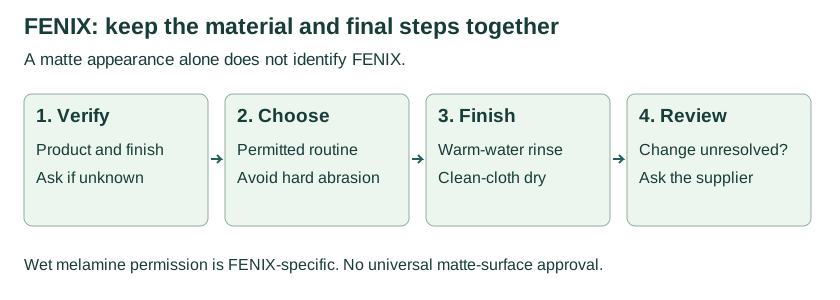
Read a deep-cleaning sequence as separate stages
The maker’s separate FENIX deep-cleaning page addresses appearance changes after material has built up over time. It names a kitchen-degreaser stage, a limescale-removing stage and a wetted nonabrasive sponge or melamine-eraser stage. Each stage has its own warm-water rinse and drying step. [2] This is a documented sequence for confirmed FENIX, not instructions to combine these products or put them on natural stone.
Before considering that route, read the complete current procedure and each actual bottle’s safety directions, and check the installation and adjacent-material restrictions. Do not invent dwell times, ratios or substitutions from the short stage names. If the guidance does not resolve a product or installation question, ask the supplier.
The page also mentions local acetone for a remaining stain with the bottle’s health and safety instructions. [2] That does not supply a household solvent recipe here. Solvent compatibility, handling and the complete procedure need to be settled before use. No heat-based scratch repair is taught in this article.
Try three original matte-surface decisions
These fictional cases distinguish instruction scopes; none is an actual cleaning test.
Case 1
A rented counter looks like the FENIX sample, but the product is unknown. Can its owner follow the FENIX limescale-remover route?
Show answer and explanation for case 1
No. Confirm the material with the supplier first.
The maker explicitly warns that similar-looking matte materials can have different cleaning-liquid resistance. Appearance alone does not satisfy the identity condition.
Case 2
An owner of confirmed FENIX removes a mark with the described wet eraser. Can they skip the final rinse because the mark is gone?
Show answer and explanation for case 2
No. Complete the documented rinse and dry.
The maker explains that residue and eraser particles can remain in the surface structure. Visible removal is not the same as completion of the care process.
Case 3
A household has Cambria Matte in one room and FENIX in another. Should both receive the same scouring or chemical treatment?
Show answer and explanation for case 3
No. Keep each product’s own restrictions.
Cambria’s no-harsh-pad and chemical restrictions do not become FENIX permissions, and the FENIX instructions do not authorize a shared treatment for every matte surface.
Keep an unresolved change visible in the care record
Download the blank countertop-care record. Fill it with the installed product and the exact instructions you have checked. Keep an unresolved condition marked as unresolved.
For FENIX, record the material and finish, supplier confirmation, cleaner name and label, cloth or pad, the known spill, steps already taken, and the appearance after the permitted rinse and drying process. If you ask the supplier for help, this record gives them the actual question rather than an assumed diagnosis.
Record which stage was actually used and whether its rinse/dry was completed. If a patch remains, describe its location and appearance and share the actual product history with the supplier. “Changed appearance, cause unresolved” is more useful than calling it a stain or claiming that a procedure has repaired it.
Sources and further reading
- Formica US: Care and Maintenance, FENIX sectionFENIX identity boundary, matte structure, routine cleaner/tool choices, rinse/dry and wet-melamine distinction.
- Formica US: Deep Cleaning FENIX SurfacesNamed deeper sequence with separate rinse/dry stages and material-specific disclaimer; no video or thermal-repair method adopted.