Practical guide
How to Clean Formica Laminate Countertops Without Flooding the Seams
For confirmed Formica laminate, use a damp nonabrasive cotton cloth and a compatible mild liquid detergent or household cleaner, then rinse with a clean cloth and clean water and dry. Do not flood the laminate, especially near seams: Formica warns that water can penetrate and swell the substrate. A laminate-floor method or a FENIX cleaning permission is a different product instruction.
Identify Formica laminate before borrowing a method
Recover the product name from the installer, invoice, supplier or landlord. A wood-look or stone-look surface does not tell you whether it is laminate, solid surfacing, quartz or another finish. Formica’s US care page also discusses FENIX, but gives it separately named instructions. Those permissions are not interchangeable. [1]
This page covers the maker’s routine for Formica laminate counters. The laminate-floor guide covers Pergo’s floor-care example, including different tools and trim boundaries. A shared word in the material name does not transfer the whole procedure.
Prepare a clean cloth and a compatible routine cleaner
Formica specifies a clean, damp, nonabrasive cotton cloth with mild liquid detergent or a household cleaner for its everyday routine. Read the actual cleaner’s intended surfaces, exclusions, use directions and precautions before selecting it. The maker’s general category does not authorize a product that excludes your counter or an undocumented mixture. [1]
Have a separate clean cloth and clean water ready for the rinse stage, plus a soft clean nonabrasive cotton cloth for drying. Check that the cloths are not carrying grit or an earlier chemical. Keep an already changed seam visible so the job does not turn into repeatedly wetting a possible repair problem.
Clean, rinse without flooding, then dry
Scroll the table sideways on a phone. Keyboard readers can focus its region and use the arrow keys.
| Stage | Maker-described action | What must stay controlled |
|---|---|---|
| Clean | Use the damp nonabrasive cotton cloth and suitable mild detergent/household cleaner; work in a rotating motion. | Material identity, product label and nonabrasive tool. |
| Rinse | Use clean water with a clean nonabrasive cotton cloth. | Do not flood the laminate, especially near seams. |
| Dry | Use a soft clean nonabrasive cotton cloth. | Finish the process instead of leaving unmanaged liquid or cleanser residue. |
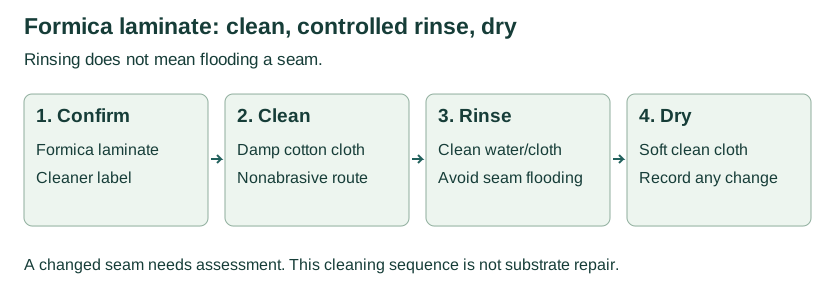
The sequence and the seam warning come directly from Formica. [1] “Rinse” is a controlled cloth step, not an instruction to pour water over a joint. Work so that you can complete all three stages with clean cloths. Do not assign an invented soaking time, water volume or dilution to a guide that does not provide it.
The labelled diagram keeps its reading size; scroll it sideways on a phone.
Keep seam condition separate from cleaning success
The maker’s reason for avoiding flooding is water penetration and substrate swelling. [1] That is a liquid-control boundary, not proof that every raised seam was caused by this morning’s cleaning. If a seam is raised, opening or visibly changed, note when it was first noticed and what liquid or products were involved if known. Ask the installer or supplier to assess it before another wet treatment.
A wiped top that looks dry does not establish the condition beneath it. Do not try to press, glue, sand or seal a seam as part of this cleaning routine. Those are repair choices that need the actual installation and product information.
Treat a tougher stain as a new instruction question
The current Formica page has separate countertop stain advice, including named solvents and a nylon-bristle brush for some stubborn marks. It also requires rinsing away all cleanser traces and drying. [1] This article does not turn those brief examples into an all-purpose chemical protocol. Obtain the complete applicable care guide and read the actual product’s health and safety directions before that route.
Tell the supplier what the mark is, if known, what cleaner has already been used, where it is relative to seams and edges, and whether the surface has changed. Do not substitute a metal blade, hard scouring pad, improvised solvent mixture or a FENIX method for the named instruction. If the mark’s cause or material remains unresolved, keep that uncertainty in the record.
For an ordinary permitted clean, follow the routine above. If residue remains after the complete process, review product and cloth compatibility and the rinse stage rather than assuming that more concentrated cleaner is the answer.
Try three original countertop decisions
The following cases are fictional instruction checks, not observed failures or repairs.
Case 1
A confirmed Formica laminate counter has a seam beside the sink. Can the owner rinse by pouring a bowl of water across it?
Show answer and explanation for case 1
No. Use the controlled clean-cloth rinse and avoid flooding.
The maker explicitly warns about water penetration and swelling, especially near seams. A rinse instruction is not unlimited liquid permission.
Case 2
A floor mop product is approved for a particular laminate floor. Does that make it the correct cleaner for a Formica countertop?
Show answer and explanation for case 2
No. Check the actual countertop and cleaner instructions.
The floor and the counter are different product scopes; the shared material term does not establish the same cleaner, tool or rinse process.
Case 3
A raised seam remains after wiping the top. Will another wet clean establish whether it is dirt or damage?
Show answer and explanation for case 3
No. Document the condition and request an assessment.
Appearance alone does not diagnose the cause. The routine does not repair or test the condition of the substrate.
Save one repeatable routine, with its limits
Download the blank countertop-care record. Fill it with the installed product and the exact instructions you have checked. Keep an unresolved condition marked as unresolved.
For Formica laminate, record the material and finish, supplier confirmation, cleaner name and label, cloth or pad, the known spill, steps already taken, and the appearance after the permitted rinse and drying process. If you ask the supplier for help, this record gives them the actual question rather than an assumed diagnosis.
For a deliberately matte FENIX surface, use the separate FENIX guide. For Cambria quartz, use its manufacturer-specific cloth and no-treatment route.
Sources and further reading
- Formica US: Care and MaintenanceFormica Brand three-step routine, seam-flooding warning, special-stain scope and separately named FENIX instructions.