How to Hand Wash Delicates
Hand wash permitted delicate garments with label-led sorting, a suitable measured detergent, gentle rinsing, supported lifting and separate drying instructions.
Plan permission, washing and drying together. A delicate garment needs its own instructions, not a general stain-removal recipe. Sort compatible items, use a suitable product, keep wet fabric supported and follow the separate drying label.
1. Read the whole care label before separating the load
“Delicates” is a useful laundry grouping, but it is not one fibre or one washing recipe. A lace bra, a fine knit, a silk blouse and an embellished garment can have different instructions. Read the finished item’s label, including washing method, water temperature, bleaching, wringing and drying restrictions. A fabric name printed on a shop tag is not enough.
Set aside dry-clean-only and do-not-wash items. For a missing or unreadable label, use the missing-label checklist and seek the maker’s guidance before water-washing. Do not decide that every item is safe just because you will work by hand. Linings, trims and finishes can need different care from the main fabric.
Check whether you can also perform the required drying method. If an item needs flat drying, make room before washing it. If the instructions require another method or contain a restriction you cannot interpret, clarify it first. Starting with only the wash symbol can leave you holding a heavy wet garment with nowhere suitable to put it.
2. Separate items by care needs, not only by colour
Group only items with compatible wash method, temperature and detergent requirements. Keep light and dark colours separate, and give new or potentially bleeding colours their own basin. ACI also advises checking trimmings and decorations for colourfastness. A small test can inform a decision, but it does not guarantee every part of a garment will behave identically.
Do not put a delicate knit in with a heavy, rough or strongly coloured item simply to save a basin of water. Check for loose fasteners, rough edges and decoration that could snag another garment. Close appropriate hooks or fastenings according to the garment instructions, and avoid pulling delicate sections while doing so. One uncertain item is easier to observe when it is washed separately.
Use a clean basin, enough room to move the garment gently, a suitable hand-wash product and clean towels or the prescribed drying support. Do not use a basin that still contains a surface-cleaning chemical. Keep each product in its labelled container, and do not mix cleaners or boosters into an improvised “delicate” solution.
3. Choose a product for this fabric and hand-washing method
Read both the garment and detergent directions. A suitable product should describe the fabric or garment type and how to use it for hand washing. Measure the directed amount for the amount of water you are using. There is no reliable universal teaspoon or capful because formulations and basin volumes differ. More foam does not establish better cleaning.
For wool, follow the specific restrictions in the wool-sweater hand-wash guide. Woolmark recommends a mild, neutral wool detergent and advises avoiding heavy-duty detergents, enzymes and bleach. Do not transfer a general stain-booster or bleach recommendation to wool. For other fibres, use the actual garment and product directions rather than assuming the wool method is universal.
Dissolve or distribute the product in water before the garment goes in, following its directions. Do not pour a concentrated dose directly over a delicate finish. A fragrance-free claim is not proof of compatibility with silk, wool, beading or a particular dye. If the available product does not identify a suitable use, pause until you have a compatible one.
4. Wet, move gently, rinse and support the garment
Use the labelled temperature and product method. Lower the item into the prepared water and let it become evenly wet. Move it gently without scrubbing, twisting or pulling against its own weight. Treat the whole garment as a delicate object rather than working every seam as if it were a stubborn stain. Stop if you notice loose decoration, a changing finish or continuing colour transfer.
Soaking time is garment- and product-specific. Woolmark’s ten-minute wool soak is not an instruction to soak every silk, lace or decorated item for ten minutes. Follow a stated time where one is provided. Leaving an item in a basin overnight because hand washing seems gentle can create a different exposure from the permitted method.
Drain the wash water with the garment supported. Rinse with fresh water according to the product and garment directions, using gentle movement until detergent is removed. Avoid a fixed rinse count or a promise that one rinse always suffices. If there is a lot of residual foam, correct the dose next time instead of applying stronger squeezing now.
Lift the garment with its weight distributed across your hands or a clean support. A heavy wet knit should not hang from one shoulder, and fine fabric should not be dragged by a strap or trim. Gentle pressing can remove excess water when permitted; do not twist it into a rope. The drying instruction may also specify do not wring or drip dry, so check before pressing.
5. Dry by the separate label instruction
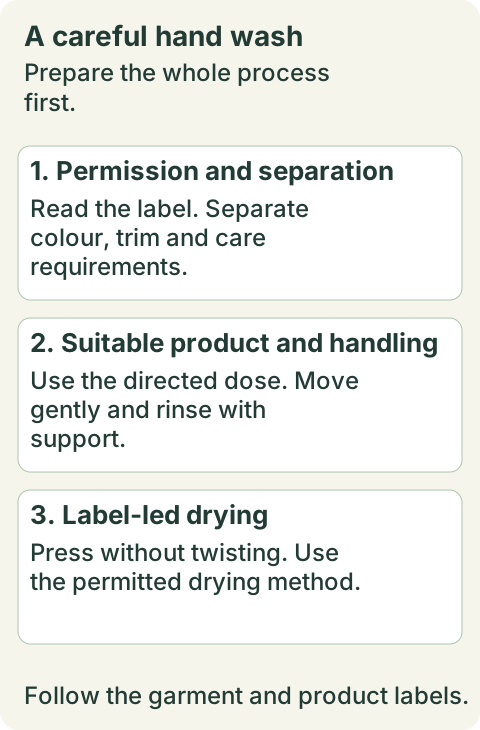
Washing permission does not automatically grant tumble-drying permission. Read the drying instruction as its own decision: flat, line, drip, shade or a permitted tumble setting can describe different handling. Use the drying care-label decision guide to compare the instruction with the options available at home.
For a wool knit that calls for flat drying, Woolmark advises gentle reshaping and natural drying away from direct heat or sunlight. A hanger can stretch wet knitwear. Other garments may have a line-dry or drip-dry instruction; do not turn the wool rule into a rule for every delicate fabric. Choose the method stated for the finished garment.
Where towel pressing is compatible with the label, use a clean pale towel and gentle pressure, without twisting or forceful stretching. Prepare a dry support and air circulation. Check seams, bands and thicker sections before storage: a surface that feels dry can coexist with a damp seam. ACI advises folding and storing clothes only when fully dry.
6. Decide separately whether a washer can be used
A washer’s Hand Wash cycle is not identical to washing physically by hand. Whirlpool describes it as using low agitation with a slower spin or no spin, while its Delicate cycle has gentle agitation with a somewhat faster spin. These are descriptions of machine programs; the exact settings and availability depend on the washer. Read your model’s manual.
Whirlpool specifically says not to put hand-wash-only garments on the Delicate cycle. A mesh bag does not change that restriction. Use the mesh-bag matching and loading guide when the garment already permits the relevant machine method. The bag can help with matching, separation and handling, but it does not make an unpermitted cycle safe.
For a machine-washable delicate, choose the garment’s permitted cycle and temperature, then check the manual’s loading and spin instructions. Avoid compressing many delicate items into a tiny bag or a full normal load. If the item is very fragile or heavily embellished, get garment-specific guidance rather than relying on a reassuring cycle name.
7. Fix the cause of the problem before repeating the wash
| Problem | What to check | Avoid |
|---|---|---|
| Dye transfers into the water | Keep the item separate and seek maker advice when bleeding continues. | Adding other garments to a strongly coloured basin. |
| The rinse remains soapy | Check dose and use fresh rinse water with support. | Wringing harder or adding another cleaning product. |
| A trim or finish changes | Stop handling and seek garment-specific advice. | Scrubbing the change as though it were a stain. |
| The wet item loses shape | Support it and use the prescribed drying method. | Lifting by a strap, shoulder or narrow seam. |
| A mark remains after the wash | Identify it and find a compatible local treatment. | Applying a general bleach or enzyme recipe. |
For a separate stain, the colourfastness testing guide explains what a small test can and cannot establish before treatment. A successful test does not cancel a no-wash instruction or guarantee the safety of every finish. Keep the garment, product and proposed treatment in the same decision.
For repeat care, write a brief note: method, temperature, product, dose, separation and drying support. If a previous wash caused damage, do not simply repeat it with more detergent. A change in size, texture, colour or trim needs its own assessment. The printable checks help you rehearse the process without using an actual garment as a test.
Check your next step
Care check 1: A blouse says hand wash only, but my washer has Delicate. Can I combine them?
No. Whirlpool explicitly advises against using the Delicate cycle for a hand-wash-only item. A machine program name does not change the blouse’s instruction. Follow the garment method, or obtain garment-specific confirmation from the maker.
Care check 2: Two dark garments look alike. Must they be safe in one basin?
No. Colour alone does not establish compatible care. Check fabric construction, trim, wash temperature, detergent and drying instructions. Wash an item separately when its dye behaviour or trim is uncertain.
Care check 3: A product says fragrance-free. Does that establish silk or wool suitability?
No. That is a product characteristic, not a garment-care permission. Read the fabric and method directions. Woolmark specifies mild neutral wool detergent and warns against enzymes and bleach for wool.
Care check 4: The garment has no stain. Should I still scrub each seam with a brush?
No. General hand washing is not a stain-removal procedure. Use gentle whole-garment handling. A stain needs a separate garment-compatible decision; friction can damage a delicate finish or construction.
Care check 5: The wash label is clear but the drying symbol is unreadable. May I use a cool dryer?
Do not infer drying permission from washing permission. Find the maker’s instructions or clarify the symbol before starting. No-heat tumble still moves the garment, and the drying method can matter as much as temperature.
Download the printable care checks and answer sheet
Sources and garment-specific limits
- American Cleaning Institute: laundry basics — Sort by colour and care requirements; select a suitable detergent and dose; read separate wash and dry instructions.
- Whirlpool: Delicate versus Hand Wash cycle — Hand-wash-only items should not be placed on Delicate; actual hand washing differs from a machine program.
- Woolmark: detergent for wool — Specific detergent restrictions when the delicate item contains wool.
- Woolmark: drying wool — Wet-knit support and flat drying for wool knitwear, subject to the care claim.
These references explain the care decisions used here. Your garment’s label and the chosen product’s directions govern the actual wash. Examples and diagrams are original teaching material; they are not tests of a particular garment or a guarantee against damage.