How to Prevent Clothes From Shrinking
Reduce avoidable shrinkage risk by matching each garment’s care label to the wash method, temperature, load and separately permitted drying method.
Cold water alone is not a complete plan. Check the finished garment’s instructions, separate incompatible care needs and choose both the wash and the dry before starting. This guide helps prevent process mistakes; it does not promise to reverse existing damage.
1. Plan the whole wash and dry before changing one setting
To reduce avoidable shrinkage risk, start with the finished garment’s care instructions and carry them through both washing and drying. Cold water is not a complete care plan. An item can still be put through an unpermitted machine method, treated with an incompatible product or dried in a way its label forbids. One cautious setting does not cancel the other decisions.
Read the wash method, temperature, bleach restrictions and drying instructions. A care label describes the finished item, including its construction, finish and trims. The fibre content is useful context, but “cotton”, “wool” or “synthetic” does not establish one universal safe routine for every garment with that word on it.
Set aside unclear or missing labels before loading a washer. Use the missing-care-label checklist to identify what you need from the maker. If the garment says do not wash or dry clean only, do not turn “I will use cold water” into a water-washing exception. A valuable or sentimental garment is a poor place to try an unverified rescue recipe.
2. Sort by compatible care, construction and colour
ACI recommends sorting by colour, fabric type and care instructions. Build a load that can share the same permitted method and temperature. Keep hand-wash-only items out of a normal washer load, separate loosely knitted or delicate garments from rough regular loads, and account for colour transfer as well as care compatibility.
Two garments made from the same fibre can still have different labels. A lined jacket, decorated top and plain shirt should not be treated as equivalent merely because their main fabrics are similar. Check the item, not only a memory of the fibre. Separate a garment while you are reading its tag so it cannot accidentally be swept into the next mixed load.
Do not pack the washer beyond its instructions. Clothes need room to move and be rinsed, and a bag stuffed tightly around several pieces is not a substitute for a compatible load. The mesh-laundry-bag guide helps match an allowed machine-wash item to a bag and loose loading. A bag does not grant machine-washing or tumble-drying permission.
3. Match method and temperature to the garment
Choose a washing method the care label permits. For a hand-wash-only item, use the labelled hand method; Whirlpool says not to place it on the Delicate cycle. For a machine-washable item, select the cycle and temperature in line with the label and your machine’s manual. Program names and default temperatures can vary between models.
Respect a stated temperature limit. Do not read it as permission to select a hotter available cycle, and do not assume that a single “cold” button solves every risk. A product also needs to work with the fabric, method and chosen temperature. If the requirements do not align, find a compatible product or ask for advice before beginning.
Measure detergent according to its directions, allowing for the stated load and water conditions. More detergent is not a shrinkage-prevention technique and can leave rinsing problems. For wool, use its specific care method and suitable wool detergent rather than copying a general enzyme or bleach recommendation. The wool-sweater guide explains that distinction.
If you are cleaning a stain, decide on a garment-compatible treatment separately. Rubbing a small patch aggressively can create a local change in colour or texture. Removing a stain and preventing a wrong whole-garment wash are related but different tasks; do not respond to “shrinking” by escalating a stain remover.
4. Treat drying permission as a separate decision
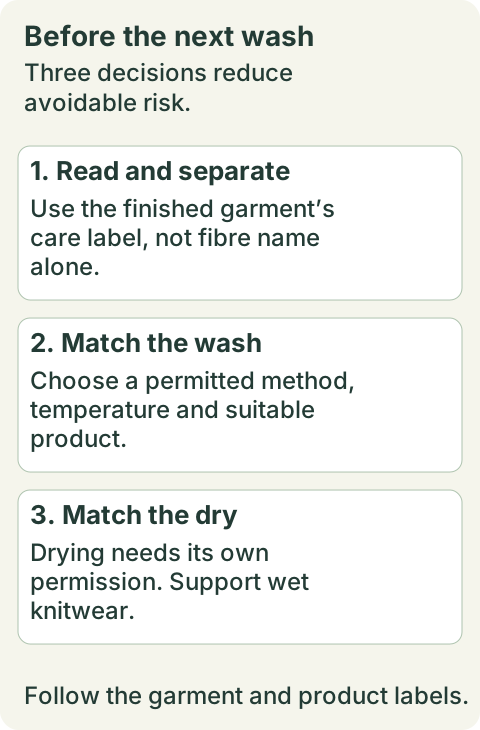
Check the drying label before the wash. Do not tumble dry means the garment should not go through a tumble method; choosing no heat does not remove the tumbling action. Flat, line and drip drying can place different loads on wet fabric. Use the tumble-dry-or-air-dry decision guide to translate a stated instruction into the correct home option.
When tumble drying is permitted, use the allowed heat and method and follow the dryer manual. Do not assume a normal high-heat program is suitable because the wash was cold. When the garment instead requires natural drying, prepare the permitted support and position. Avoid converting “air dry” into one universal hanger method for every fabric.
Woolmark recommends flat drying for knitwear unless its care claim permits tumble drying. A wet knit hung from shoulders can stretch under its own weight, which is a different size problem from becoming smaller. Gently reshape it while supported, keep it away from direct heat and sunlight, and let it dry naturally. Do not pull it forcefully to a guessed measurement.
Allow enough time and check thick seams, cuffs and waistbands before storing. ACI advises folding and putting away clothes only when fully dry. A saturated towel or poor air circulation can make drying take longer. Improve the permitted drying setup; do not replace it with an unpermitted radiator or dryer shortcut because you want the garment tomorrow morning.
5. Use item-specific decisions instead of universal fibre promises
| Item or instruction | Decision before the wash | Decision after the wash |
|---|---|---|
| Hand-wash-only blouse | Use the stated hand method and suitable product. | Follow its separate drying instruction; do not infer tumble permission. |
| Washable wool sweater | Check the care claim and use a suitable wool method. | Support the wet knit, reshape gently and flat-dry when instructed. |
| Machine-washable everyday shirt | Match the label to the manual’s cycle, temperature and load. | Use only its permitted drying method and heat. |
| Decorated or lined garment | Check the finished item and any trim restrictions. | Avoid hanging or tumbling that conflicts with its label. |
| Missing or unreadable label | Find the maker’s instruction before choosing a water method. | Clarify drying permission before creating a wet garment. |
A label-based plan cannot promise that every item will retain exactly the same dimensions indefinitely. Manufacturing, finish, construction, prior damage and the actual process can matter. This guide’s practical contribution is to reduce avoidable errors: the wrong method, excessive handling, unpermitted heat or a drying support that distorts wet fabric.
Keep the specific question in view. “Can I tumble dry this shirt?” needs the shirt’s drying instruction. “Can I hand wash this wool sweater?” needs its care claim and a wool-compatible method. A general fibre chart cannot answer either question on its own. The printable care plan records the exact item rather than asking you to remember a generic rule.
6. If size or texture has already changed, stop and document
Do not assume every dimensional change is reversible or has one cause. A sweater may be stretched in one area, smaller overall, or different in texture. Repeated soaking, forceful stretching or a household conditioner recipe can introduce another uncontrolled treatment. This guide does not verify a universal “unshrink” method.
Write down the garment’s style or identifying information, label, detergent, wash method, temperature setting and drying method. Note what changed: length, width, a particular sleeve, surface texture or trim. Photographs can help you explain the issue to the maker or a professional cleaner. Ask for garment-specific advice before trying to restore a valuable item.
For the next wash, correct the actual process mistake if one is known. A hand-wash-only piece belongs outside a normal load; an item that must not tumble needs a prepared natural drying place; a wet knit needs support. Buying a stronger cleaner does not correct any of those decisions. Keep the garment note with the care plan so the same error is less likely to recur.
7. Make the care plan easy to follow on a busy day
Set up a separate place for garments with special instructions. Read tags while sorting rather than after the machine starts, and prepare the drying support before creating a wet item. Check the washer’s selected cycle and temperature each time rather than assuming the last user left the appropriate defaults.
Use a short note with five fields: garment, permitted wash, temperature, product dose and permitted dry. If another person does the laundry, those specific instructions are more useful than “be gentle.” The original checks below practise common decision errors. They are hypothetical examples and are not reports of testing a particular fabric.
When several items have different care needs, choose separate processes instead of trying to invent one setting that covers everything. A repeatable label-led routine gives you a clear place to catch errors. It also makes later troubleshooting more useful because you can explain what you actually did, rather than just saying the wash was cold.
Check your next step
Care check 1: A label permits washing at 30°C. Must I always choose the hottest available setting?
No. A permitted temperature is a boundary to respect, not a reason to pick a hotter cycle. Match the garment, product and washer instructions. Do not choose a temperature above the garment’s stated limit.
Care check 2: The garment says do not tumble dry. Is Air Fluff an exception?
No. No-heat tumble still subjects the garment to movement. A do-not-tumble instruction concerns the drying method, not only heat. Use the separately permitted flat, line or drip method.
Care check 3: All items in a mixed load are cotton. Does that prove compatible care?
No. The finished garments can differ in construction, trim, finish and care instructions. Sort by compatible method and temperature as well as colour and soil, not by a fibre name alone.
Care check 4: A wool sweater was washed gently but hung wet from its shoulders. Is the size change necessarily shrinkage?
No. A wet knit can stretch under its own weight. Washing and drying are separate stages, and changed dimensions do not all have the same cause. Support and flat-dry knitwear when its label calls for that method.
Care check 5: A garment is already much smaller. Can a conditioner soak be promised to restore it?
No. This guide does not verify a universal unshrinking treatment or guarantee reversal of a changed knit or finish. Stop repeated experiments and seek garment-specific advice, especially for a valuable item.
Download the printable care checks and answer sheet
Sources and garment-specific limits
- American Cleaning Institute: laundry basics — Sort by care requirements, use suitable cycles, avoid overloading and read wash and dry symbols.
- Woolmark: washing wool sweaters — Wool care depends on the garment’s care claim and permitted washing method.
- Woolmark: drying wool — Wet-knit stretching, flat drying and avoiding direct heat and sunlight.
- Whirlpool: Delicate versus Hand Wash — Program names do not override garment care instructions; hand-wash-only items should not use Delicate.
These references explain the care decisions used here. Your garment’s label and the chosen product’s directions govern the actual wash. Examples and diagrams are original teaching material; they are not tests of a particular garment or a guarantee against damage.